Compliance Audit Risk & Facility Liability
Healthcare facility service providers face a content marketing challenge: educating facility managers about compliance risks while demonstrating expertise that wins contracts. The facilities that choose your services are ones finding clear, actionable compliance guidance—not generic sales pitches. Systematic documentation practices become your differentiator when you can explain both audit risk and liability protection in ways competitors can’t.
Joint Commission audit failures create marketing opportunities
When facilities fail Joint Commission audits, they search for expert guidance. Correction costs typically range from $50,000 to $250,000. Covering everything from emergency protocol updates to staff retraining and documentation overhauls. Beyond direct expenses, reputational damage affects referral networks and patient trust—metrics that take months to rebuild.
Your content marketing addresses this anxiety directly. Facilities with active citations face higher insurance premiums, coverage restrictions, or outright policy non-renewals. This liability trail follows facilities through regulatory databases. When your blog explains how systematic documentation defends against both audit risk and insurance complications, you position your company as the expert that understands their operational reality—not just another vendor selling cleaning services.
Documentation expertise differentiates your marketing
Incomplete cleaning logs, missing disinfection timestamps, and undocumented protocol changes account for the majority of infection prevention compliance failures. When inspectors find gaps in daily terminal cleaning records or cannot verify high-touch surface protocols, facilities face immediate deficiency citations that trigger corrective action plans.
Your content explains these technical details in practical terms. A systematic cleaning protocol framework creates audit-ready documentation by standardizing terminal cleaning checklists, disinfectant contact time verification, and equipment tracking across all facility zones. This framework prevents the operational shutdowns and license suspensions that occur when auditors cannot confirm infection control measures. When you publish content explaining this framework, facility managers see your company as a compliance partner—not just a service provider.
CDC Standards & Joint Commission Requirements
The regulatory framework governing healthcare facility cleaning in 2026 centers on two primary authorities: the Centers for Disease Control and Prevention (CDC) guidelines and Joint Commission accreditation standards. CDC Standard Precautions apply across all healthcare settings, requiring specific cleaning frequencies and EPA-registered disinfectants with defined contact times for environmental surfaces. Transmission-Based Precautions layer additional protocols for facilities handling infectious disease cases, mandating room-specific cleaning procedures and enhanced personal protective equipment use.
Joint Commission standards focus on verifiable infection prevention documentation and staff training records. Element EC.02.02.01 requires healthcare facilities to maintain detailed cleaning logs that document surface type, chemical used, contact time achieved, and staff member responsible. Accreditation surveys examine three core documentation categories: cleaning frequency logs that track high-touch surfaces (bed rails, call buttons, doorknobs, light switches) cleaned at minimum intervals specified by CDC guidance; chemical inventory systems that demonstrate proper storage, dilution ratios, and Safety Data Sheet accessibility; and staff certification records proving competency in bloodborne pathogen protocols and disinfectant application techniques.
Facility-Specific Protocol Variations
Hospitals operating under inpatient care regulations face the most stringent requirements, with patient room surfaces requiring disinfection between every occupant and high-touch areas cleaned multiple times per shift. Surgical centers must document terminal cleaning procedures after each case, including specific wipe-down sequences and air exchange verification before the next patient enters. Urgent care facilities follow ambulatory care standards that permit less frequent deep cleaning but still require between-patient disinfection of examination surfaces and equipment.
OSHA integration addresses chemical safety through documented staff training on hazard communication, proper dilution procedures to prevent respiratory irritation, and spill response protocols. Facilities must maintain chemical concentration testing logs that verify dilution accuracy, protecting both cleaning efficacy and worker safety. State health departments conduct surprise inspections that cross-reference these documentation elements, making records systems necessary for avoiding citations that trigger insurance reviews and potential coverage limitations.
Regional Health Department Mandates
Beyond federal CDC guidelines and Joint Commission standards, healthcare facility managers face a compliance layer many overlook: state and local health department regulations that often exceed baseline requirements. Each state maintains its own infection prevention standards, and facility managers must identify which regional mandates apply to their operations. California’s Title 22 regulations, for example, specify disinfectant contact times stricter than CDC protocols, while New York State Department of Health requires documented environmental pathogen monitoring in addition to standard cleaning logs.
Local health departments conduct inspections using jurisdiction-specific checklists that vary from federal audit frameworks. Citation patterns reveal that environmental contamination incidents—particularly in patient care areas—trigger the most frequent violations during unannounced inspections. Facility managers need to obtain their local health department’s current inspection checklist and citation history to understand what inspectors prioritize. These documents, typically available through public records requests or health department websites, show exactly which cleaning protocol elements receive scrutiny.
Seasonal considerations add another compliance dimension. May through August brings respiratory pathogen transmission patterns that differ from winter influenza seasons. Spring-to-summer transition requires updated disinfection protocols for air-conditioned environments where respiratory droplets behave differently than in heated winter facilities. State health departments in regions with seasonal population shifts often issue supplemental guidance for warm-weather pathogen prevention that facility managers must incorporate into their protocols.
Environmental contamination incidents carry mandatory reporting requirements in most jurisdictions. When cleaning failures contribute to healthcare-associated infections, facility managers must document the incident, remediation steps, and protocol adjustments according to state-specific timelines—typically within 24 to 72 hours. Missing these reporting windows compounds the original compliance failure with an administrative violation.
Systematic Protocol Framework
Healthcare facility service providers can translate overlapping regulatory requirements into marketing content that demonstrates expertise. Your blog explains how a unified cleaning protocol framework consolidates CDC infection prevention guidelines, Joint Commission environmental standards, and regional health department mandates into daily procedures. The structure addresses pre-cleaning pathogen risk assessment, area-specific frequency scheduling, disinfectant selection protocols, training validation procedures, and documentation workflows that satisfy all compliance layers.
Pre-Cleaning Assessment and Frequency Matrix
The framework begins with a facility-wide risk stratification process that categorizes areas by patient contact intensity and pathogen exposure potential. High-risk zones including operating rooms, intensive care units, and dialysis treatment areas require terminal cleaning after each patient encounter plus twice-daily environmental surface disinfection. Medium-risk areas such as examination rooms and urgent care treatment spaces need post-patient cleaning with daily disinfection. Administrative zones and public waiting areas follow standard commercial protocols with daily surface cleaning and weekly treatment.
Hospitals, surgical centers, urgent care facilities, and dialysis centers each require customized frequency matrices that account for patient volume patterns, procedure types, and immunocompromised population density. The framework provides decision trees that facility managers use to assign cleaning frequencies based on these operational characteristics rather than generic templates that fail audit scrutiny.
Disinfectant Selection and Documentation Integration
Chemical selection protocols within the framework match EPA-registered disinfectants to specific pathogens based on facility infection data and seasonal epidemiological patterns. For May 2026 spring-to-summer transitions, protocols adjust for increased respiratory virus transmission risks and humidity-related bacterial growth patterns. The framework specifies contact time requirements, dilution ratios, and application methods for each facility zone, eliminating guesswork that creates compliance gaps during audits.
Documentation templates embedded in the framework capture cleaning completion times, chemical lot numbers, staff member signatures, and environmental monitoring results in formats that correspond to Joint Commission documentation standards and state health department reporting requirements. Training validation procedures include competency checklists that demonstrate staff understanding of pathogen-specific cleaning protocols, proper personal protective equipment use, and incident reporting procedures. These integrated documentation systems create audit trails that connect daily cleaning activities to regulatory requirements without requiring facility managers to interpret compliance standards or design tracking systems independently.
Documentation & Audit Readiness
Auditors evaluate healthcare facilities through documentation review, examining whether cleaning protocols exist on paper and whether staff execution matches written procedures. A compliant record system contains five interconnected components: (1) daily cleaning schedules with date stamps, time notations, and staff initials; (2) area-specific frequency logs that track high-touch surface sanitation intervals; (3) training records documenting staff competency verification with dates and topics; (4) chemical tracking systems including safety data sheets, dilution calculations, and application logs; and (5) incident reports with root cause analysis and corrective action follow-up.
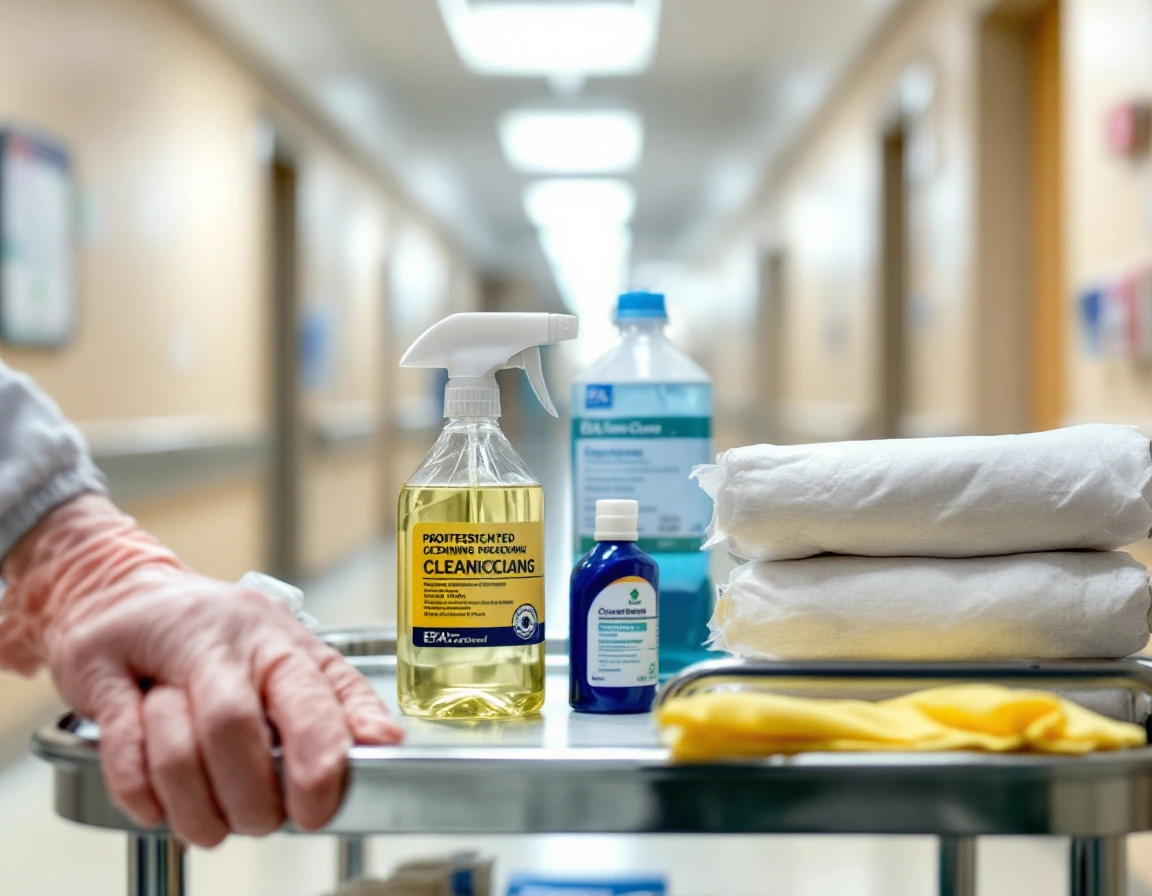
Daily cleaning logs satisfy Joint Commission and state inspection standards when they identify the specific room or department cleaned, list the surfaces addressed, document the products applied with EPA registration numbers, and include both the completion timestamp and the staff member’s signature. These logs create verifiable audit trails that connect cleaning activities to infection prevention outcomes. Training records must extend beyond attendance rosters to include competency assessment results, certification dates for bloodborne pathogen protocols, and dated acknowledgment forms confirming staff understanding of facility-specific procedures.
Chemical inventory documentation requires three-layered tracking: safety data sheets accessible at point-of-use locations, dilution ratio records that match manufacturer specifications and facility protocols, and application logs noting which chemicals were used in which areas on which dates. This documentation protects facilities during incident investigations by demonstrating proper storage conditions, appropriate product selection for specific pathogens, and staff adherence to contact time requirements.
Pre-Audit Self-Assessment Protocol
Facility managers should conduct quarterly documentation reviews using a structured checklist:
(1) Verify that all cleaning logs contain required data elements for the past ninety days
(2) Confirm training records include competency verification for each active staff member
(3) Check that chemical inventory matches physical stock with current safety data sheets
(4) Review incident reports to confirm documented corrective actions were implemented
(5) Test whether any auditor could reconstruct cleaning activities from documentation alone without staff interviews
This self-assessment process identifies gaps before external reviewers arrive, converting documentation from a compliance burden into operational protection against citations and liability exposure.
Content Marketing for Facility Service Providers
PublishPuffin solves the expertise gap that prevents most facility service companies from publishing consistent compliance content. Our platform generates facility-specific cleaning protocol explanations, regulatory update summaries, and documentation guidance calibrated to your exact service offerings, regional jurisdiction, and target facility types. Instead of hiring compliance consultants at consultant rates or tasking existing staff with blog writing beyond their expertise, you can generate expert-level content that matches CDC standards and Joint Commission requirements.
The marketing advantage extends beyond initial blog posts. When CDC updates environmental cleaning guidelines or state health departments modify seasonal infection control mandates, PublishPuffin regenerates affected content automatically. Your spring transition blog updates to reflect May 2026 pathogen surveillance data without manual research or article revision. Training material explanations adapt to reflect current disinfectant approval lists. Frequency matrix guidance adjusts when Joint Commission clarifies surface classification standards.
This approach delivers both cost reduction and consistency improvement. You avoid recurring writer contracts while maintaining expertise-level content quality. Your blog stays current with regulatory changes instead of becoming outdated between content sprints. Educational materials and facility guides maintain consistency across your marketing without manual editing. Compliance blog posts adapt to seasonal infection patterns—May surface contamination content differs from December respiratory season articles—without your team tracking every guideline modification.
PublishPuffin transforms compliance content from a resource-intensive specialist function into a regular operational capability. You maintain thought leadership continuously rather than scrambling to publish before industry conferences. Schedule a demo to see how PublishPuffin handles your facility services content workflow.